

Clinch. Throw. Armbar.
“Two <female> pioneers, one cage.”

Brutalities-A Love Story, had been sitting in a pile on my desk for probably two years. I don’t know why I put off reading it, but after reading Courtney Maum’s Substack referencing the book I cracked it open. Let’s just say it may be one of the most honest, raw and vulnerable memoirs I’ve read. Brutalities was published in 2023 and this isn’t a book review. This is a first pass at what I hope will be an essay that further explores a world that Steines’ revealed to me. Not the world of BDSM and the life of a dominatrix, but the world of MMA (Mixed Martial Arts). Her memoir was the primary trigger for my curiosity, but as synchronicity would have it, second and secondarily, was the UFC spectacle on the White House lawn.

There were no women participating in Trump’s birthday bash inside the “Cage.” There were the “ring card girls,” that I’ve learned are an integral part of MMA events, who signal rounds and “enhance” the atmosphere. I was an avid watcher of the Friday night fights when I was a kid. Sitting on my grandfather’s lap, we’d tune into the Gillette Cavalcade of Sports and I’d always root for the underdog. Though my favorite boxer was no underdog–Sugar Ray Robinson–and I even got his autograph at a special evening hosted by the synagogue I attended as a child. Back then there were no ring girls. This was the first I’d heard of them–scantily clad in outfits specially designed to reflect the patriotic fervor of the event they paraded around between rounds.
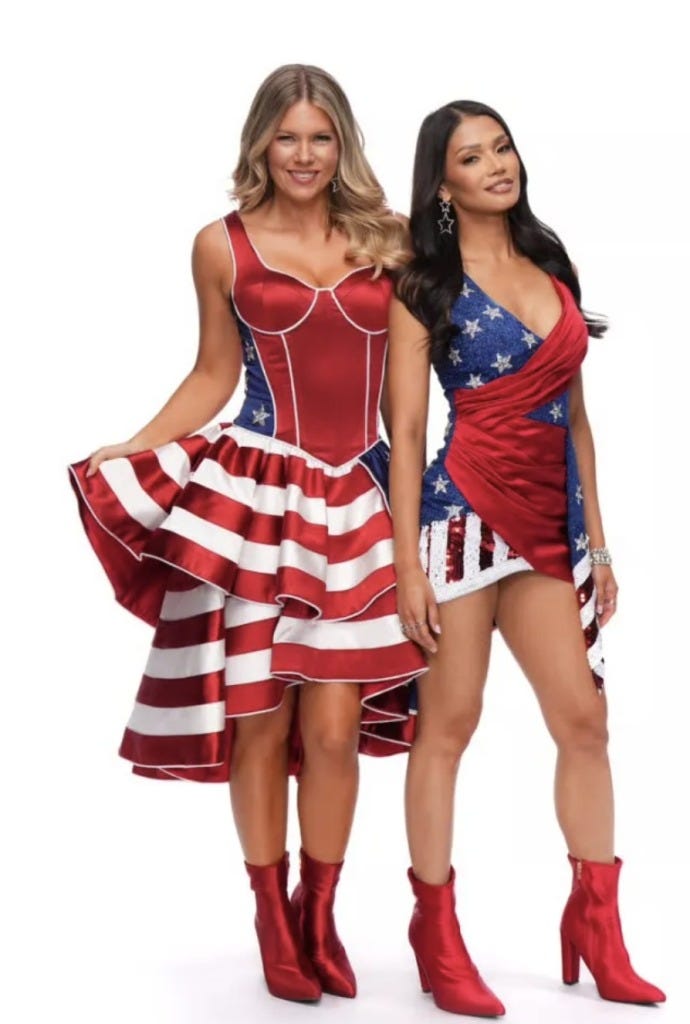
So why the absence of women other than the ring card girls? From what I’ve inferred–Dana White more or less said s—t happens. Instead, a double-comeback bout between Ronda Rousey and Gina Carano was held on Netflix, the first live MMA event broadcast there, which attracted the most U.S. viewers in the sport’s history. I watched it after the fact.
Because of the buildup for their cage reunion, the Rousey-Carano event was the last of five fights on the schedule. I watched the first two matches before fast-forwarding to their event. I saw half-naked men pummeling, kicking and choking each other into submission. The two fights ended in the first round, one by a KO, the other by a cut stoppage–it was pretty bloody. As much as I’m horrified, I’m also drawn in. I’m not supposed to like it. I’m supposed to stop watching. Not just hold my breath. Like the five-year old kid. I don’t understand the pull just as I don’t understand offering one’s self up for being hurt–badly.
“Two pioneers, one cage.” Blink and you could’ve missed Rousey, thirty-nine-years-old, who was performing in a mixed martial arts cage for the first time in nearly a decade, defeat forty-four year old Carano who was fighting for the first time in seventeen years. Gina Carano had been the face of women’s MMA, the first woman to headline an MMA event. And a star in Muy Thai. Rousey took it further. “Amazing sport…amazing athletes.” I wanted to understand the “amazing.” Who are they?
Both have transcended the sport of MMA and it was Rousey who changed Dana White’s mind about women participating in events, even if they weren’t at the White House.
Fifteen seconds in their fight was over. Carano down. Rousey described as an “explosive grappler.” Clinch. Throw. An armbar–her armbar–the most feared submission in MMA history. Backstory: Rousey’s mother, the first American world champion in judo, would wake Rousey up every morning when she was a child, by putting her in an armbar.
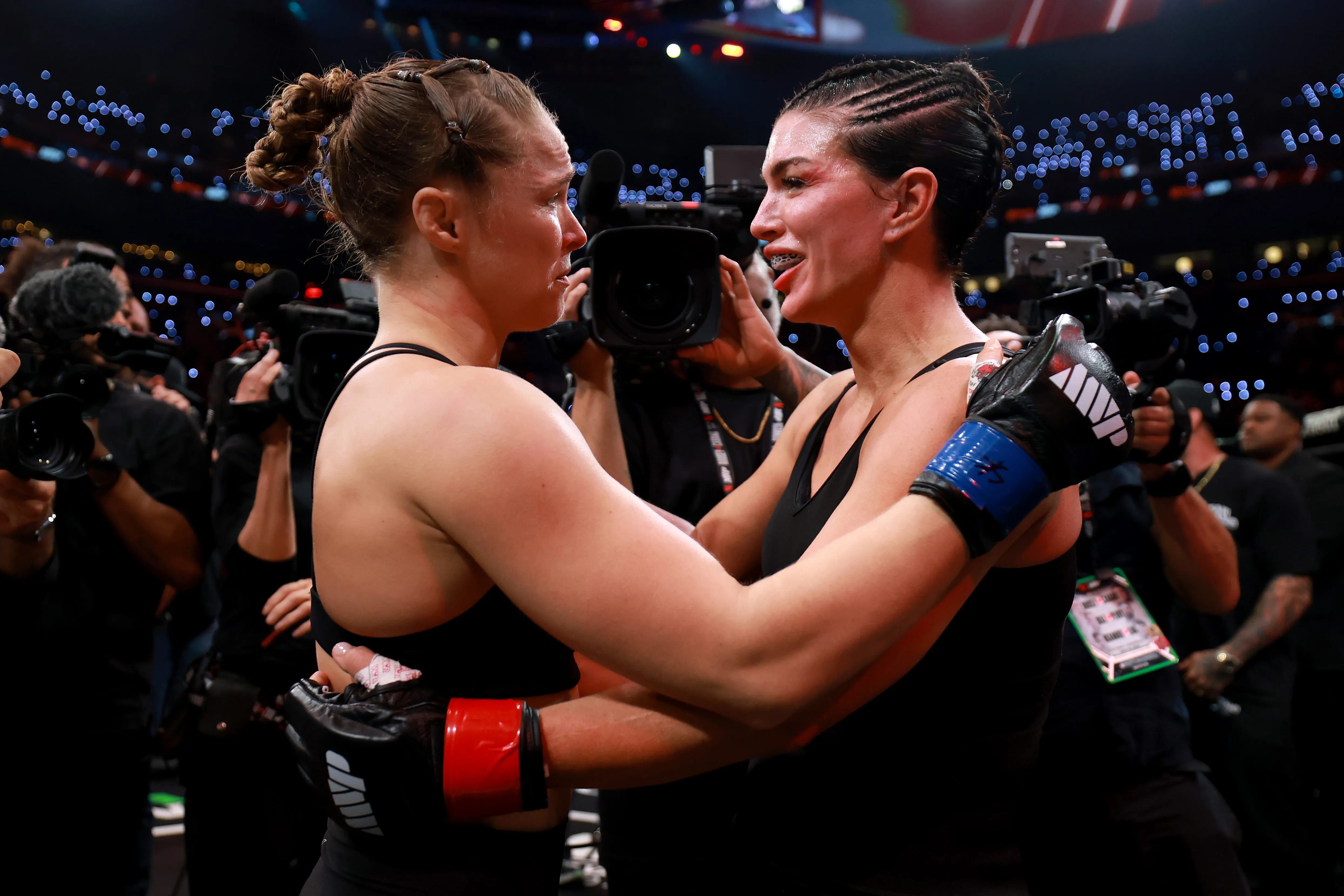
Then they were both embracing and crying. Guys don’t do that.
A long-time friend of mine is a Nth degree black belt in karate and runs her own school. She stopped being able to watch fighting. “The cage fighting has so much of the Brazilian jujitsu where you take the person down. It’s painful as it’s something I’ve done. I’ve hurt and been hurt.” The sport of bashing each other’s brains in. Yet she’s an avid consumer of Gladiators, a British television series that presents Contenders who compete against the show’s resident Gladiators, in accelerating physically challenging events.
There’s a story behind the Rousey-Carano meet-up. Carano had gotten in trouble, physically and emotionally and Rousey reached out to her, suggesting a match. It worked. So certainly, for them, there’s more than what we, what I saw in the flash of arms and legs and take-down. I’ve yet to understand the coexistence and expression of such extreme emotions.
“Am I going to worry about where I’m landing in history? I’m sorry I just don’t.” (Rousey)
“Doing hard things, makes you start to live again.” (Carano) How different is that from what so many of us say to ourselves?

In further writing I plan to explore the relationship between violence and sexuality. Afterall, Fifty Shades of Grey was on the bestseller list for one hundred weeks, more than fifteen million copies of the first book were sold in the U.S. and Canada; the movie is the eleventh highest-grossing R-rated film ever made. Parenthetically, sixty-eight percent of North American audiences were female. What’s that about? Whether it’s in the ring or in the bed we’re talking about consensual violence. I’m interested in your thoughts.
Characteristically, you have picked an unexpected topic and given us information that we do not know. Thank you for another angle. I'd love to see you take this topic further. F
The razor’s edge between anger/violence/sex is a film called 9 and 1/2 weeks